
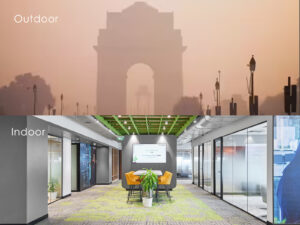
In India, office interior designs are shaped as much by climate as they are by design intent. High summer temperatures, prolonged periods of humidity, fluctuating winters, and consistently high levels of urban pollution create challenging conditions for indoor environments. These factors influence not only thermal comfort, but also material performance, energy consumption, and the overall quality of office indoor air.
As weather patterns become increasingly unpredictable and employees spend longer hours indoors, the performance of office indoor air quality is under closer scrutiny. Today, office interior designing is conceptualised around solutions that enable employee health and productivity, especially in a climate where air quality index (AQI) continues to significantly get affected across major cities in India. In this context, office interior designing requires innovation. While AQI affects the outdoors, Indoor Air Quality, or IAQ, is a critical design consideration, directly linking external environmental conditions with interior planning, material selection, and long-term usability.
What Defines Office Indoor Air Quality?

When viewed through an office interior design lens, IAQ extends far beyond air filtration or temperature control; it defines how a space feels throughout the day and across seasons. The absence of heaviness and discomfort and the ability to focus without fatigue are all outcomes of well-considered office indoor air quality.
In recent years, urban air quality has continued to deteriorate. For multi-national corporations’ (MNCs) office interior designers in Bangalore, Gurugram, Chennai and Hyderabad, have placed office indoor air quality at the forefront of workspace design. As climate patterns grow more volatile, what has become essential is how office interior solutions are responsibly enabled.
Designing for Indian Climate
The Indian climate presents a particularly complex design challenge in this regard. Most offices must perform under drastically different conditions within a single year. For example, office interior designers in Bangalore would have completely different office interior solutions to address office indoor air quality than those in Gurugram and New Delhi. In response, office interior designs can no longer rely solely on mechanical solutions. Spatial planning becomes critical, with layouts that reduce heat accumulation and allow air to move naturally through the space.
Office Interior Design Solutions To Combat Poor IAQ
Higher ceilings, thoughtfully proportioned volumes, and materials that remain cool to the touch contribute to an environment that feels comfortable without appearing over-engineered. In such spaces, comfort is expressed through restraint and intelligence rather than excess.
For office interior designers, this necessitates a deeper understanding of how materials behave over time and under varying conditions. In winters, office interiors become more enclosed and heating systems are activated, often leading to dry air and reduced ventilation. This can result in discomfort and a noticeable decline in office indoor air quality.
Overlaying these seasonal variations is the persistent reality of urban pollution. In cities such as Delhi, Mumbai, Bengaluru, and Chennai, outdoor air quality has a direct and measurable impact on indoor environments. Office interior solutions must, then, regulate office indoor air quality and instill occupant comfort.
The transition from outside to inside becomes a critical design point, with entry spaces, lobbies, and buffer zones playing an important role in protecting any office’s indoor air quality. Within the workspace, surfaces and finishes are chosen not only for their visual appeal but also for their ability to resist dust accumulation and support easier maintenance. In this context, clean air becomes an unspoken marker of quality and care for any office interior design.
Read Also: Best Indoor Office Plants for Modern Office
Responsible Office Interior Designing
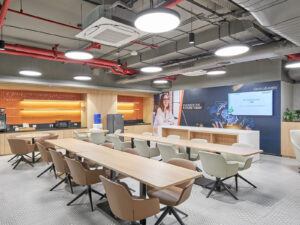
Achieving high office indoor air quality while maintaining design integrity requires early and close collaboration between office interior designers, architects, and building services consultants. Environmental considerations need to be integrated without disrupting the aesthetic narrative. Elements such as exposed ducts or generic vents can be concealed through false ceiling/soffits or custom-designed elements, allowing office interior designs to feel cohesive and effortless.
Material selection is where IAQ becomes most tangible in office interior designing. Increased focus on wellness and sustainability has drawn attention to the emissions and performance of paints, adhesives, sealants, and furnishings. It calls for a more informed approach in which natural materials are valued for their authenticity and longevity, and high-performance finishes are selected for their contribution to healthier indoor environments.
Looking ahead, the greatest challenge lies in designing offices that can adapt to an uncertain climatic future. Workspaces must therefore be flexible and responsive, capable of adjusting to seasonal and environmental shifts without extensive intervention. Smart systems that monitor and optimise air quality, along with adaptable spatial planning, allow offices to evolve alongside changing conditions. In this sense, IAQ becomes a dynamic design strategy rather than a static benchmark.
As expectations around workplace quality continue to rise, innovative office interior solutions are being explored. Across major Indian cities shaped by rapid urbanisation and global corporate standards, interior designers in Bengaluru, New Delhi, and Gurugram occupy a pivotal role. They are no longer responsible only for the visual identity of offices, but also for shaping the invisible environments that support health, performance, and well-being.
Frequently Asked Questions
- Why is Indoor Air Quality becoming a priority in office interior design, especially in India?
Indoor Air Quality has become a critical concern as offices in India function under extreme and highly variable climatic conditions, alongside persistently high levels of outdoor pollution in urban environments. Since employees spend the majority of their workday indoors, inadequate IAQ has a direct impact on comfort, health, and overall productivity. - How do seasonal weather changes impact IAQ in office interiors?
Seasonal shifts significantly affect indoor environments. High summer temperatures increase cooling demand and can lead to stagnant air if not managed correctly. Effective office interior design solutions anticipate these changes and integrate systems, materials, and layouts that maintain consistent air quality throughout the year. - Can high IAQ standards be achieved without compromising aesthetics?
High IAQ standards can be achieved without affecting design. Concealed systems, custom vents, and coordinated ceilings and lighting help keep IAQ solutions unobtrusive. Clients are also recognising that responsible material choices add long-term value to a space. - How can office interior designers influence IAQ beyond HVAC systems?
Office interior designers play a critical role in IAQ through material selection, detailing, and spatial planning. Choices such as low-emission finishes, breathable materials, dust-resistant surfaces, and thoughtful zoning directly affect how air moves and settles within a space.